Yonga.io
EV Charging Data Platform for Turkey — Web, API and MCP
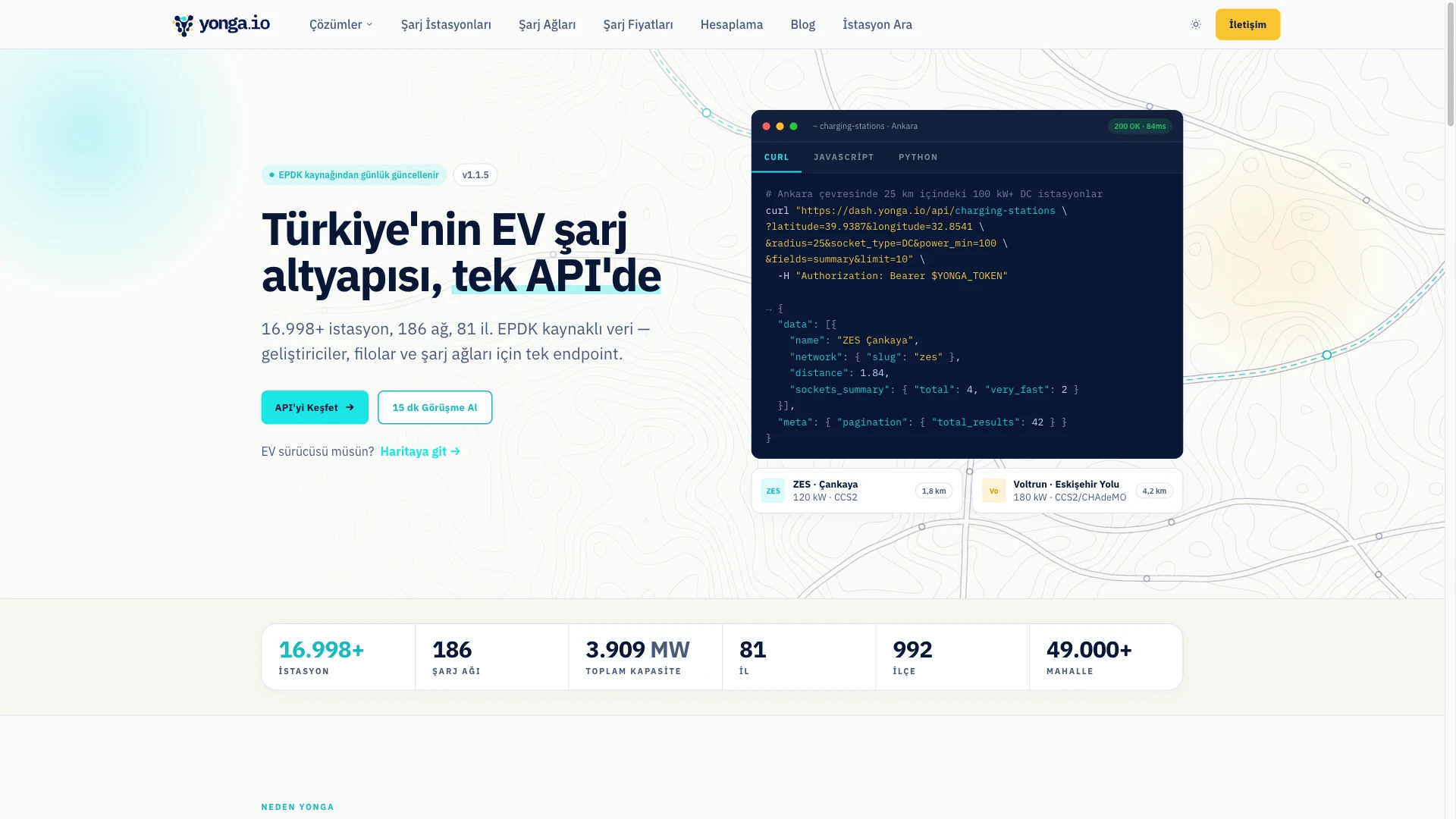
Yonga.io is a data platform for electric vehicle (EV) charging in Turkey. Kozmoz designed and developed it. Drivers, businesses and AI agents use the same verified data through a website, an API and an MCP server.
2025
About the Project
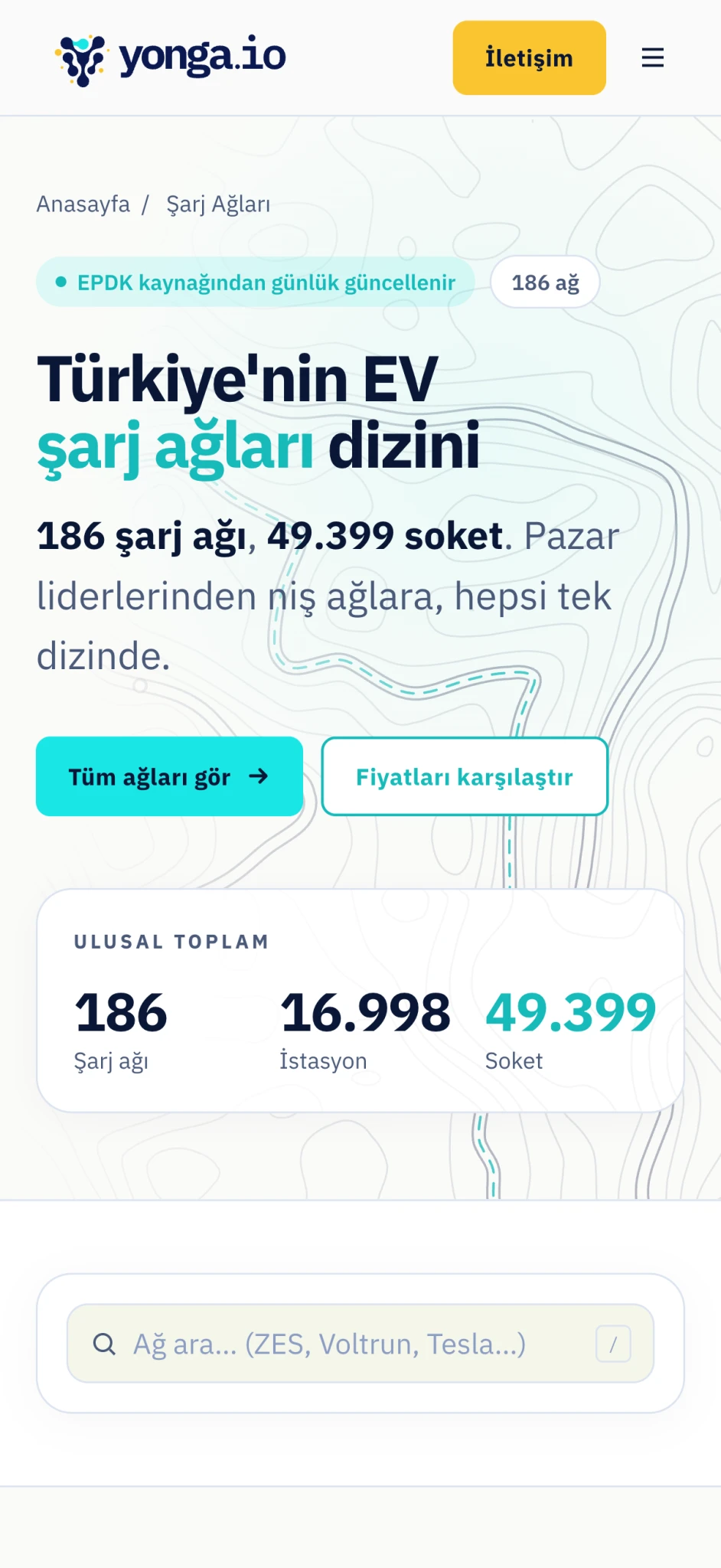
Yonga.io gives a clear and reliable map of EV charging in Turkey. Each station shows the network operator, the address, the socket types and the power capacity. Yonga refreshes and validates this data on a regular schedule.
The project started in 2025 as a map for drivers. In 2026 it became a data platform with three products:
- Website — a Turkish guide to stations, networks, prices and charging calculators.
- Brand Identity Design — Logo and brand ID is deisgned for yonga project
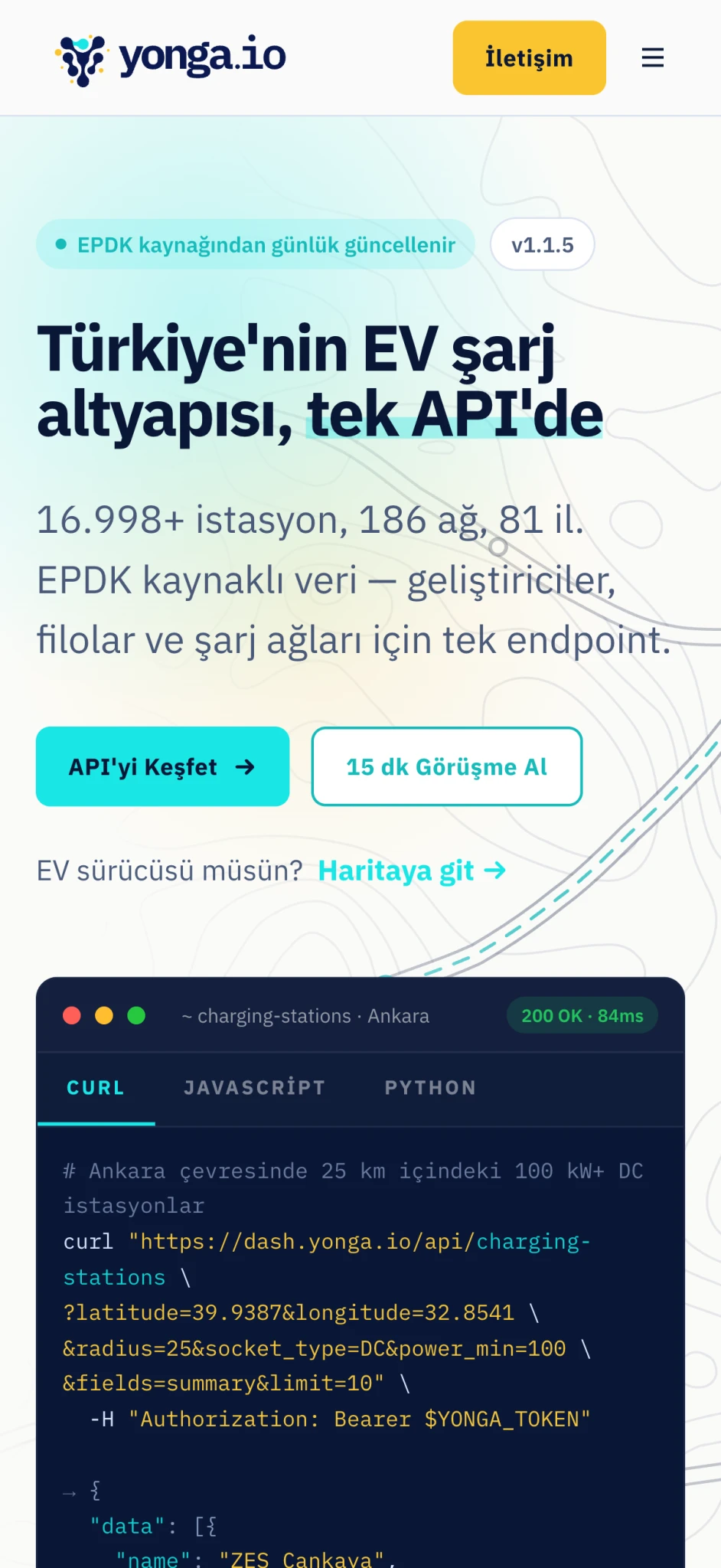
- Yonga API — station, network and geography data for developers and businesses.
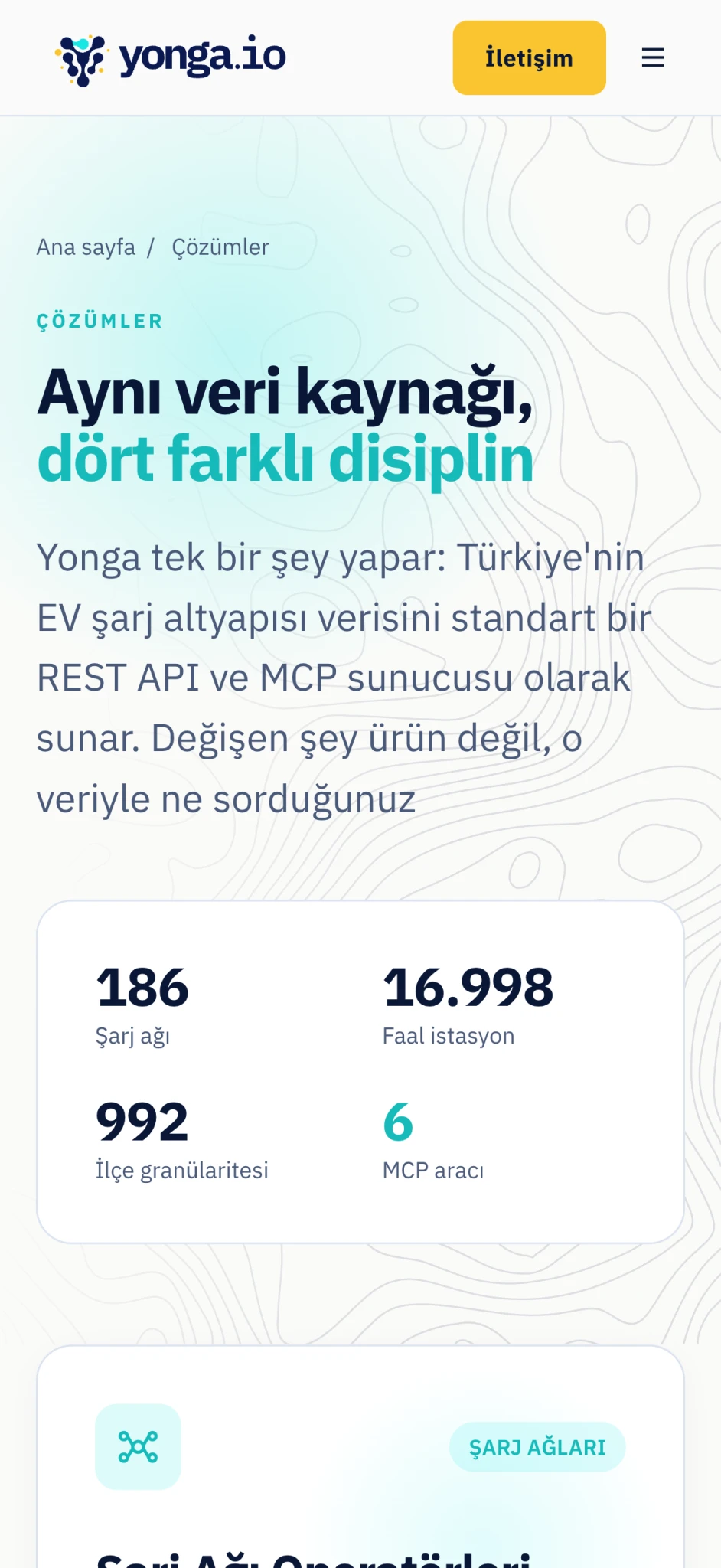
- Yonga MCP server — live charging data for AI assistants such as Claude and ChatGPT.
At a Glance
17,000+
Active charging stations
186
Charging networks
81 / 992 / 49,000+
Provinces / districts / neighbourhoods
3
Products on one dataset: website, API, MCP server
The Challenge
The Energy Market Regulatory Authority (EPDK) keeps the official registry of charging stations. This registry is the most reliable source, but it is difficult to use directly:
- The official service has strict rate limits. It is not designed for apps or analysis.
- Records are raw. Addresses are free text, and locations need validation.
- Prices, apps and contact details are on each operator's own website.
- AI assistants do not have live and structured data about Turkish charging stations.
Our Approach
- One dataset, three products. A correction in one place shows on the website, in the API and in the MCP server.
- Official source first. EPDK data is the base. Yonga adds location validation, geography and operator details.
- Honest data. Each page shows only what the data supports. Solution pages also say what Yonga does not supply.
- A map pin is a promise. The map shows only active stations that are open to the public.
Design
Logomark
The Yonga.io logomark is the centre of the visual identity. Kozmoz made it with a custom generative design tool built with p5.js. The tool makes variations of the mark from a set of rules. The mark has versions for light and dark backgrounds.
Visual Identity
- Colour: Electric Teal (
#0FCECE) is the main colour. Navy backgrounds give contrast. Gold (#F5C53A) marks highlights. - Typography: Exo 2 and Figtree.
- Data first: Maps, numbers and tables are the main visual elements.
Generative Pattern
The same generative system also makes the Yonga.io pattern. The pattern gives the brand a flexible visual texture for backgrounds and visuals. Per-province share images use live data and show a district density map with key statistics.
Product Design
- Clear structure. Pages follow Turkey's administrative levels: province → district → neighbourhood → station. Each network has its own page.
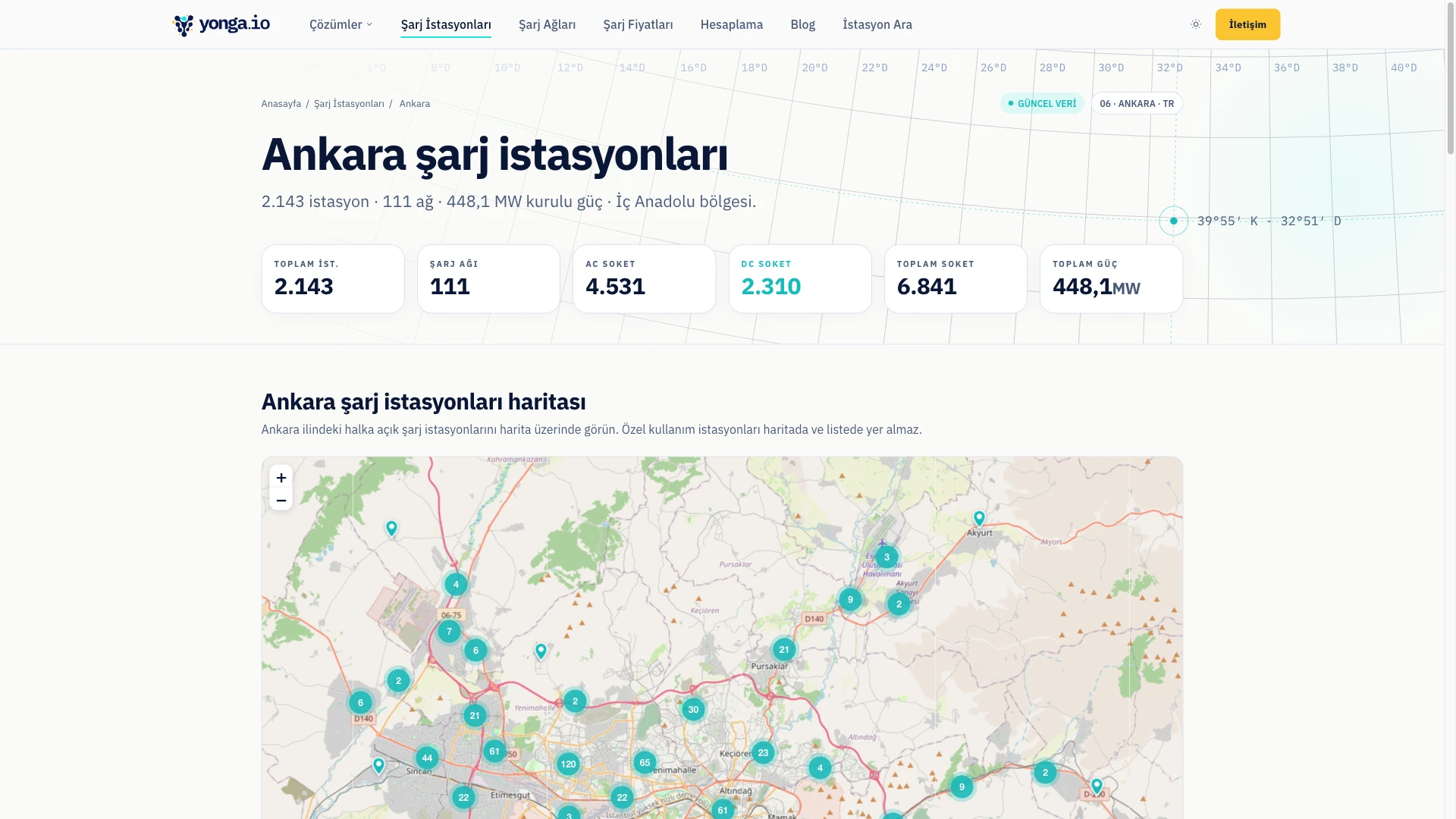
- Useful station pages. Each page shows sockets, connector types and power. One click opens the station in Google Maps, Yandex Maps or Apple Maps.
- Quality before search. AI writes a draft description for each station. An editor approves it before the page enters search engines.
Data Pipeline
- Collect — Yonga syncs stations and sockets from the EPDK registry.
- Structure — Each address goes into province, district and neighbourhood.
- Validate — Google Maps services confirm each location.
- Enrich — AI collects operator prices, apps and contact details. The team reviews the results in a custom dashboard.
- Track — When a station leaves the registry, Yonga marks it inactive and keeps its history.
Yonga API
The Yonga API gives standard and high-volume access to all charging data in JSON format.
Access has tiers, from Free to Enterprise. Responses stay small: callers select only the fields they need, and map boundaries come in a light, map-ready form. Full documentation is on yonga.io/docs.
- Stations — filter by province, district, network, connector type, AC/DC and power. Search by keyword or by distance.
- Networks — operator details, apps and tariffs.
- Geography — 81 provinces, 992 districts and about 49,000 neighbourhoods, with charging totals and map boundaries.
- Changes — lists of new and removed stations and networks.
Yonga MCP Server
The Model Context Protocol (MCP) is an open standard that connects AI assistants to tools and data. With the Yonga MCP server, an AI assistant answers EV charging questions about Turkey with live data. Users can ask in Turkish or in English.
Six tools cover the main questions: station search, station details, nearby stations, network list, network details and geography.
Designed for AI agents:
- Short answers by default, to save the agent's context.
- One call answers "how many" and "which operators" questions.
- One geography tool covers province, district and neighbourhood.
Connection
Claude.ai and ChatGPT users add Yonga as a connector and sign in. There is no key to copy. Developer tools such as Claude Code and Cursor use a personal access token.
Example questions
- "Kadıköy'de hangi şarj ağları var?" (Which networks are in Kadıköy?)
- "Find DC chargers within 2 km of me."
- "What are Trugo's prices?"
Web Platform
The first version of yonga.io (2025) was a static Eleventy site. In 2026 Kozmoz rebuilt it with Nuxt.
- Fast pages. Key pages are built in advance. Other pages are made on request and kept in cache.
- Secure by design. API keys stay on the server and never go to the browser.
- Maps and tools. Interactive maps, a charging cost calculator, a charging time calculator and a price table.
- Turkish search. Search ignores Turkish accents, so "kadikoy" finds "Kadıköy".
- SEO continuity. The new site kept the old URLs to protect search rankings.
Impact
Yonga.io is more than a directory. It is a growing map of the EV charging ecosystem in Turkey.
- Drivers find a station, check its sockets and get directions.
- Network operators see their position in the market.
- Fleet, enterprise and public sector teams monitor infrastructure growth.
- Developers add Turkish charging data to their products with one API.
- AI assistants give current answers about charging in Turkey.
Accurate and open information helps build a more connected and sustainable electric mobility future.
Tech Stack
- Website: Nuxt, Vue, Tailwind CSS, Leaflet maps
- Backend: PHP Laravel, PostgreSQL, custom admin dashboard
- API and AI: REST API with OpenAPI documentation, MCP server, secure sign-in for AI assistants
- Data sources: EPDK registry, Google Maps services, AI-assisted enrichment
- Design: p5.js generative design tools
Explore Yonga.io
- Search charging stations by province and district
- Show the stations near your location
- Open a station in Google Maps, Yandex Maps or Apple Maps
- Compare network prices and calculate charging cost and time
- Connect Yonga.io to Claude or ChatGPT

Betik.ai
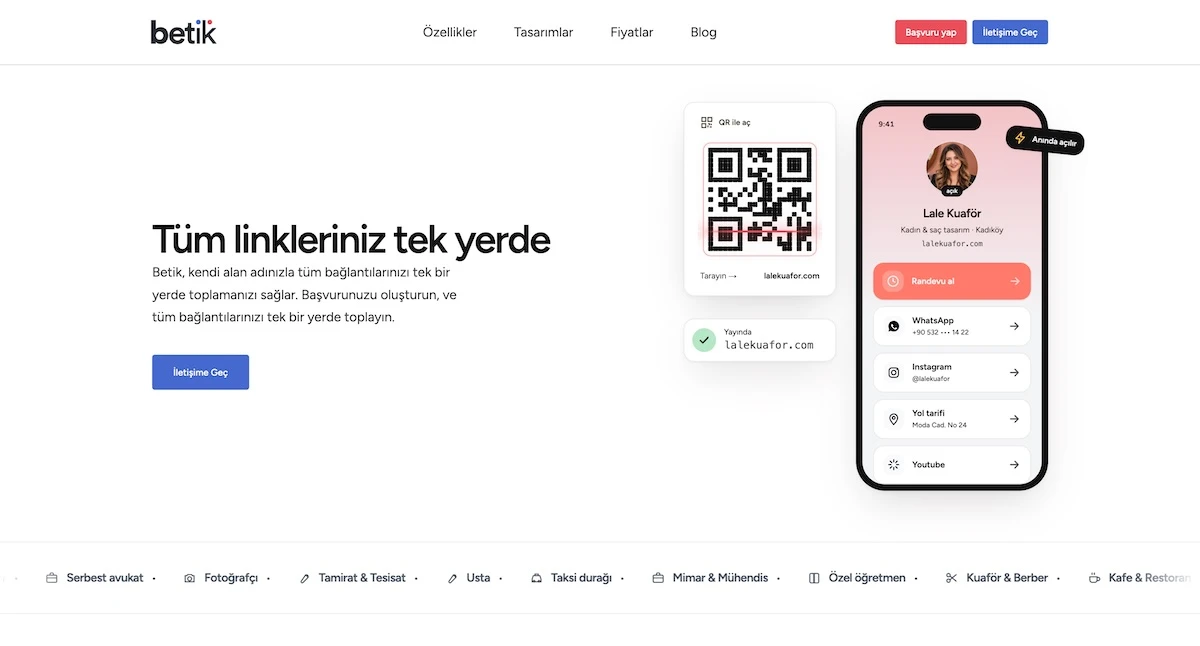
Betik turns local businesses into a single, professional digital destination.